
Leadership Wisdom of the Week #30
“Pain is inevitable. Suffering is optional.”
– Haruki Murakami, What I talk about when I talk about running
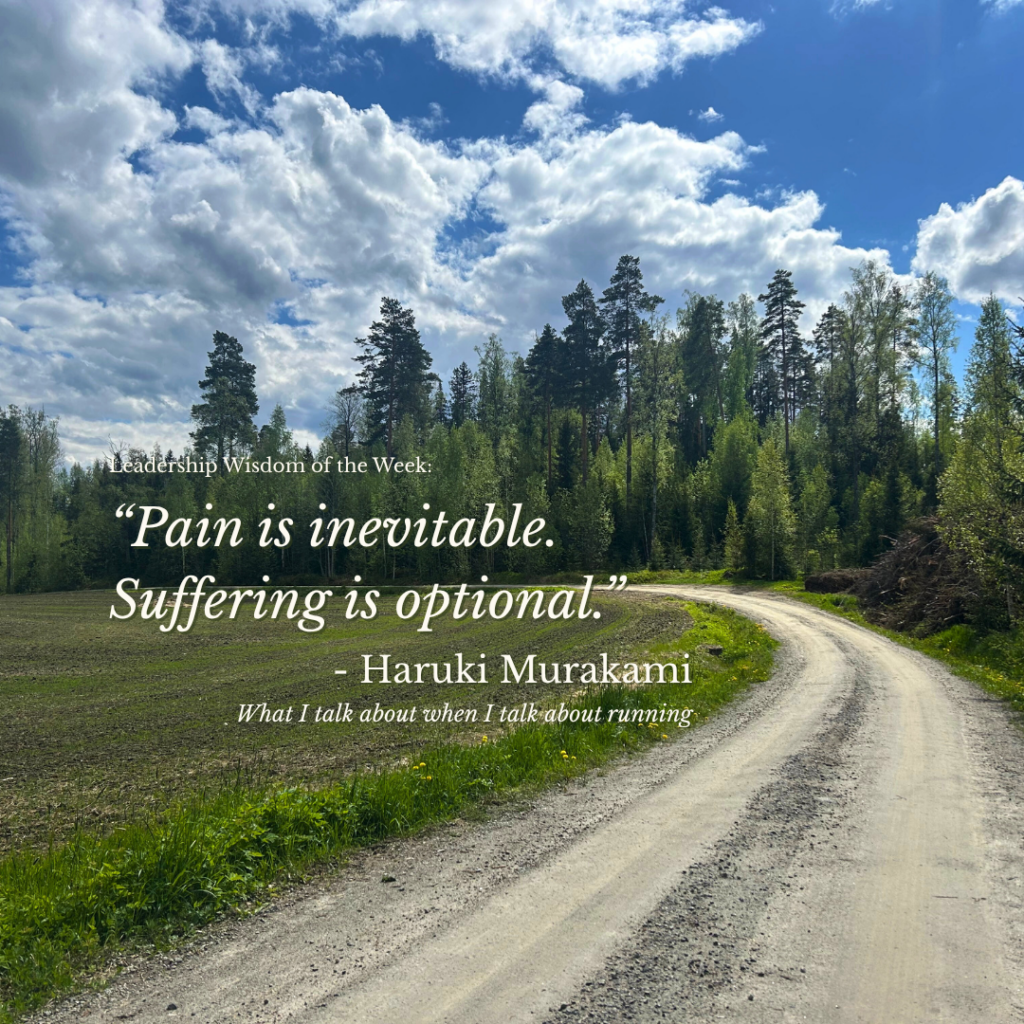
This week’s quote is very personal. It comes from a book in which Murakami, a famous Japanese author, connects running and life in a way that resonates with me.
Last Saturday, I ran the Tampere half-marathon. My time was more than half an hour slower than my personal best and 10–15 minutes slower than I had hoped to run at my current level of fitness. And yet, I am happy. This was my first half-marathon in three years, and I gave it the best I had on the day. It was painful, and for the last two or three kilometres, I kept running through sheer willpower.
This is the power of long-distance running for me. You can have a clear target and still appreciate your achievement when you fall short of it. You know the training you have put in and the effort it took to finish. There are plenty of people — fitter, more athletic and younger than me — who could have run the same time with much less preparation. That does not take anything away from what this meant to me. It was a major milestone on my way back to running, and I showed myself that I could do it.
Back at home, I looked through my husband’s collection of running books and started reading Murakami to make sense of the mental side of this experience. This quote, a mantra he had read about, captured something important. The pain was real, but I knew why I was willing to go through it. Missing my target did not make the effort any less worthwhile.
How can we find this same drive at work? The willingness to work towards something meaningful, even when the outcome is uncertain, and the ability to appreciate our effort and progress when the result falls short of what we hoped for?
When we know why something matters, we can be more willing to accept the difficulty involved. A setback or a mistake can be part of the journey, rather than a judgement on our worth.
As leaders, we can help others see that purpose and recognise their progress. Do people know why their effort matters? And do we help them appreciate what they have achieved, even when there is still further to go? At its best, work should be about making a real impact on what matters most. Yet the constant rush from one thing to another can turn it into a need to keep proving our worth. We easily lose sight of why we are doing what we are doing.
This is what I love about running: the simplicity of knowing why I am putting in the time and covering the kilometres. The effort is mine, the purpose is clear, and I can be proud of how far I have come and still want to go further.
Leadership Wisdom of the Week: Why?
This year, I decided to explore new ideas about leadership—but also to revisit and reflect on some old favourites. And I felt like sharing the most important ones with you.
These insights come from many different sources: leadership researchers and philosophers, but also from some of my favourite songwriters and fiction writers. What matters is that each of them has made me reflect on something essential about leadership.